2026-06-15
Meet the Artist Bringing the Liturgy of the Hours to Life - YouTube
- beautiful video on the sacred perspective of art
Meet the Man Behind the Most Beautiful Books in the World - YouTube
- denmark + japan are craftsman countries
great essay on reformed zoomer
illustration of the ambiguity of the word love, from reformed zoomer:
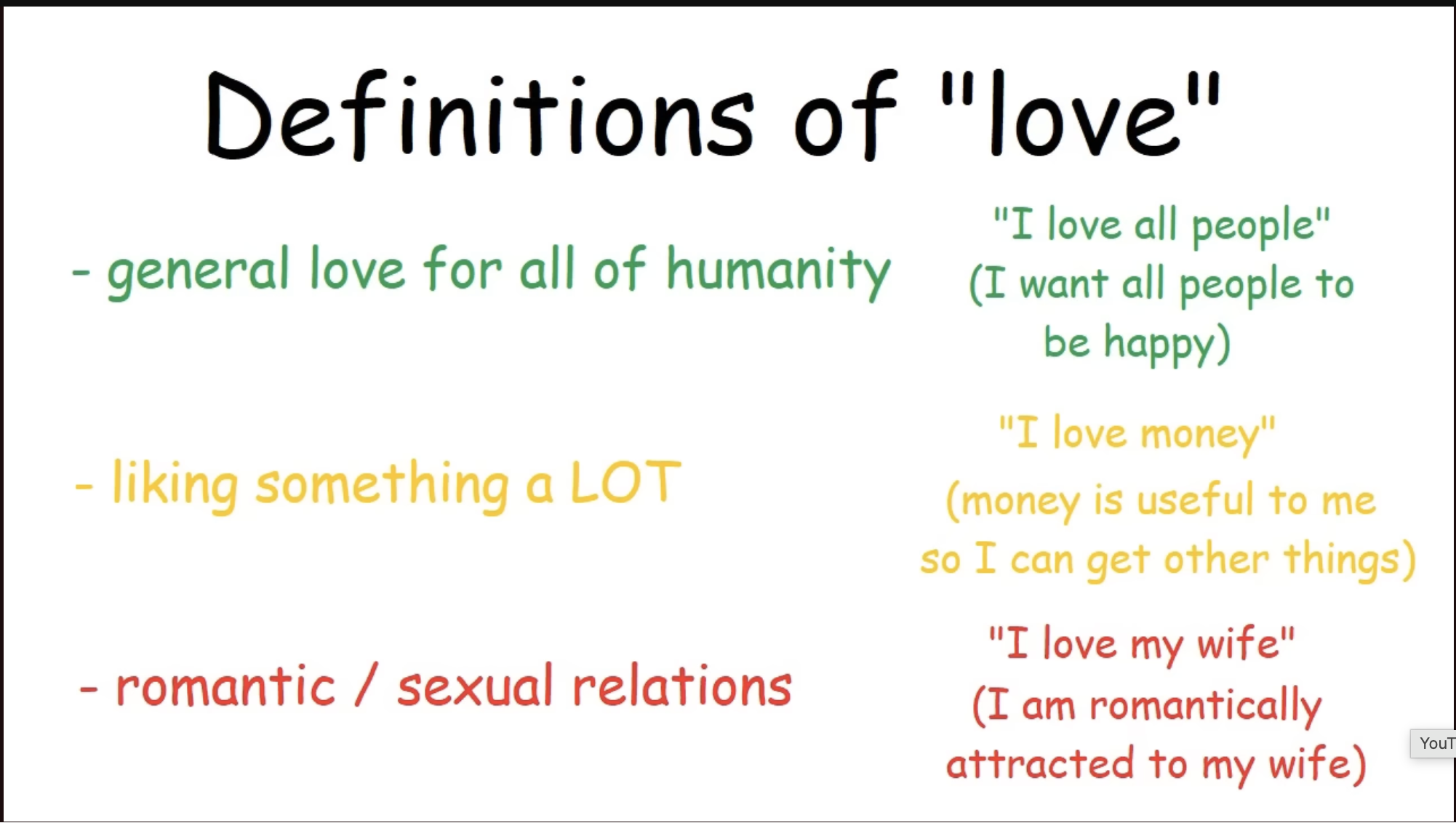
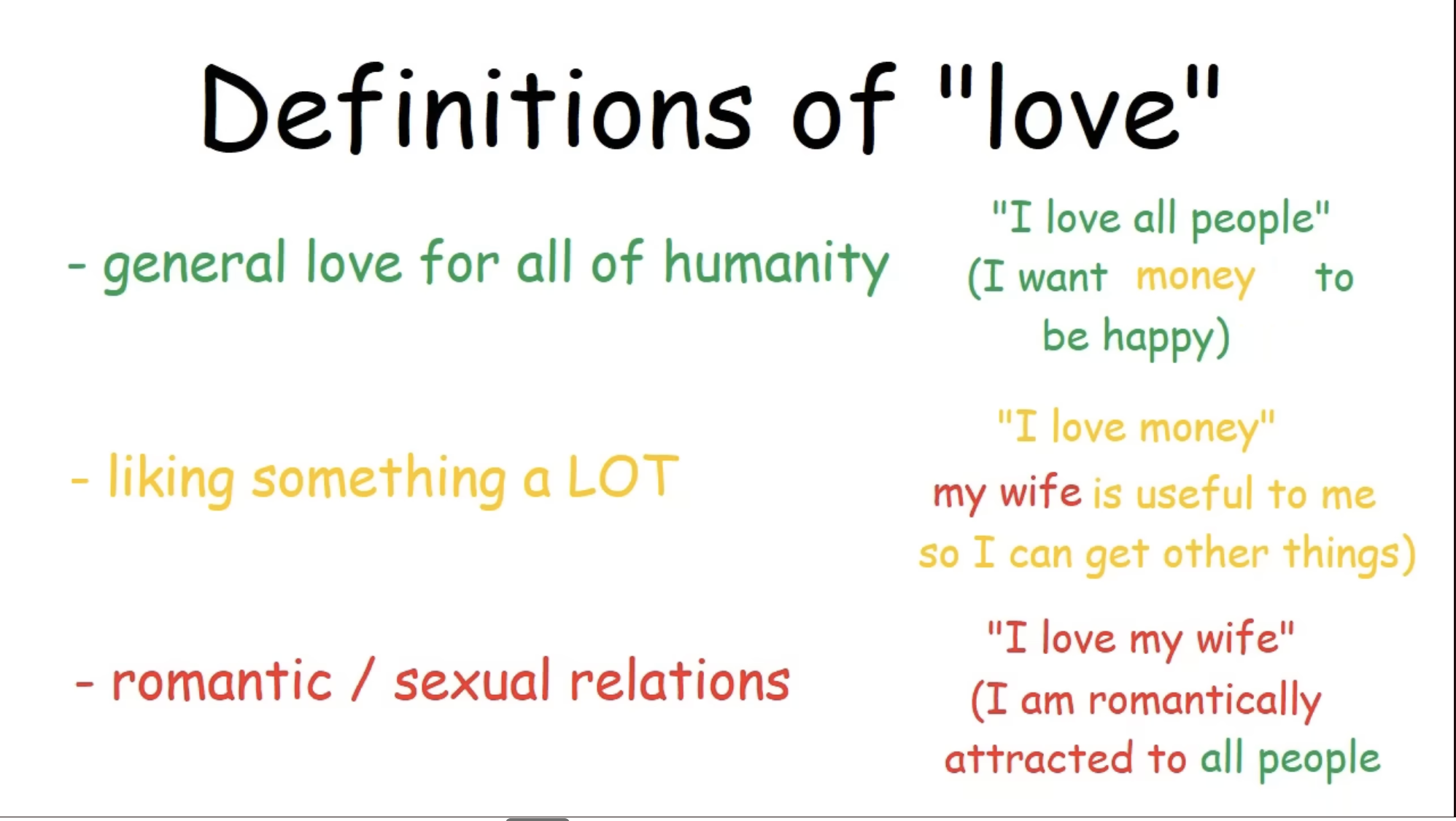
he uses the incest argument to justify that forms of relationship are important, not just consent.
but some progressives would surely say incest is not bad if it does not produce any defective offspring. and that a moral intuition against incest is just evolutionary biological conditioning that is now outdated.
(paul addresses incest in 1 Corinthians 5:1)
another: John 6 DEBUNKS transubstantiation
- reformed argument: john 6 says "Whoever eats my flesh and drinks my blood has eternal life, and I will raise them up at the last day. For my flesh is real food and my blood is real drink"
- well what about non-believers who take the eucharist? do they still have eternal life? if the eucharist is the literal body and blood, then according to john 6, they do. but this is a contradiction because non-believers cannot have eternal life
- Council of Constance (1415)—and later the Council of Trent (1563)—formally prohibited the chalice to the laity over fear of mis-handling and spills
- jan hus burned at the stake for saying people should take both types of communions, everyone who agrees is also burned at the stake
- Theologically, the Church taught that Christ is "fully present" in both the bread and the wine. This is the doctrine of concomitance: because Christ’s body and blood are inseparable in his resurrected state, receiving the Host (the bread) meant you were receiving the whole of Christ—Body, Blood, Soul, and Divinity.
- Catholics argue that the sacrifice of the Mass by the priest requires both bread and wine to represent the "separation" of Christ's body and blood that occurred at His death on the Cross. This is why the priest must consume both at the altar as part of the sacrificial / consecration rite. However, the consecrated eucharist is fully available in either form to laity because you are receiving the same Person (Christ) both ways
- "If the Mass is the memorial of the Passion, the sign must adequately represent the nature of the Passion—which was the violent separation of Christ's life-blood from His body"
You can argue endlessly and deciding which argument is superior (dual species is only part of the sacrifice vs is part of the sacrament). The only thing that makes sense to me is that there is one church that the holy spirit works through. If we do not trust in this, our relationship to christ is at the mercy of individual theological argumentation. I don't think humans can handle this. Aquinas says similar on the part of the summa about the necessity for revelation.
There must be one church then, and we should be devoted to it like a spouse. Working with it rather than divorcing.
cbt and theology
- CBT is Learning to recognize one’s distortions in thinking that are creating problems, and then to reevaluate them in light of reality.
- Theology, in some sense, is then CBT
- The Concept of "Right Thinking" (Metanoia): In many religious traditions, the internal life is the seat of action. The Greek term metanoia, often translated as "repentance," literally means "to change one's mind" or "to have a transformation of consciousness."
- Externalizing Truth: CBT encourages patients to look at evidence outside of their emotional bias. Theology often encourages practitioners to look at "Scripture" or "Divine Truth" as an objective standard. When a person feels "I am unlovable" (a common distortion), CBT asks for evidence; theology might point to an objective belief that "You are created in the image of the Divine." Both aim to replace a subjective, painful narrative with a more stable, externalized truth.
- The Power of Narrative: Both disciplines emphasize that our internal narratives dictate our emotional health. CBT focuses on "automatic negative thoughts," while theology often focuses on "temptation," "lies," or "erroneous beliefs" that lead the individual away from a state of peace or alignment with God.
- However, the distinction lies in the Source of Authority. In CBT, the individual is the final arbiter of what constitutes a "healthier" thought. In theology, the practitioner submits their thoughts to an authority or framework that exists beyond their own logic.
- The Problem with "Penance": A significant rift in the history of the term occurred with the Latin translation of the Bible (The Vulgate). St. Jerome translated metanoia as poenitentiam agere ("to do penance"). This shifted the focus from an internal, cognitive transformation to an external, transactional performance—a debt to be paid for a sin committed.
- "we call the prostration of the body, a bow to the ground, a metanoia: it is a gesture of the body that reminds the soul to bow down in spirit. You may find that after a long day at work or study, your mind is so distracted that the only way you can pray is by using your body first. Then, at the lighting of a candle and incense, the slowing of the breath, the momentum of a metanoia, the nous follows suit and manages to tune into the prayer."
Husserl spoke of the "natural attitude"—the unreflexive way we move through the world, assuming our immediate perceptions are the absolute truth. We see things through the "horizon" of our past experiences, biases, and desires.