
I got an email from Earthjustice this morning exhorting me to tell our government not to lease deep sea minerals to corporations.
Here is their argument:
Knowledge is limited about the deep-sea environments and marine life that will be affected — and potentially irreparably harmed — by mining extraction. Therefore, I am urging the Bureau of Ocean Energy Management to stop this leasing process and listen to the countless countries, scientists, marine policy experts, businesses, financial institutions, Indigenous leaders, and civil society groups worldwide calling for a moratorium on deep sea mining.
Instead, there are alternatives to deep-sea mining that we should be considering. Deep sea mining is an industry that doesn’t currently exist at scale or meaningfully contribute to the economy. We can continue to prioritize:
** innovation in battery technologies that do not require critical minerals and instead use easier-to-source elements;
** circular economy practices like increased recovery, responsible recycling, repurposing, refurbishing, repairing, and reuse; and
** the continued extraction of metals from existing and established sources under improved environmental and social governance rules.
The clean energy transition can be achieved without risking the destruction of the deep ocean.
You can find the government request for information and interest here.
—-
Obviously running giant underwater bulldozers that indiscriminately scoop up ocean bed and smash through coral reefs with spinning blades that kill octopi is bad and we should not do that.
But, being the annoying skeptic that I am, I would still like to know:
Does the deep ocean ecosystem rely on critical minerals for health?
Are there non-invasive ways to harvest critical minerals from the ocean? Maybe tiny little cute sea-floor-friendly harvester robots?
The answer is yes. They do.
Deep sea mining is a problem of epistemic humility.
Our current Secretary of the Interior is Mr. Doug Burgum, a software businessman turned real-estate developer with no environmental science background:
After graduating from North Dakota State University in 1978 with a bachelor’s degree in university studies and earning an MBA from Stanford University two years later, he mortgaged inherited farmland in 1983 to invest in Great Plains Software in Fargo. Becoming its president in 1984, he took the company public in 1997. Burgum sold the company to Microsoft for $1.1 billion in 2001. While working at Microsoft, he managed Microsoft Business Solutions. He has served as board chairman for Australian software company Atlassian and SuccessFactors. Burgum is the founder of Kilbourne Group, a Fargo-based real-estate development firm, and also is the co-founder of Arthur Ventures, a software venture capital group.
Personally, I don’t think a real-estate developer has the right worldview to steward our nation’s ecosystems.
I assume Mr. Doug Burgum had a similar thought as me: do the fish really need the cobalt? But instead of spend five minutes to look it up, he just thought about it on his own. Fish don’t eat cobalt, therefore, let’s get it.
Fish aren’t eating cobalt, it’s true. But the minerals on the deep sea floor serve as a vital component in an extremely complex ecosystem we do not even begin to understand.
Some humbling phrases:
Dark oxygen is oxygen magically produced by mineral deposits
“Polymetallic nodule fields” (Burgum’s mining targets) support “highly vulnerable abyssal fauna much of which lives attached to nodules or in the sediment immediately beneath it”
Such science is above my pay grade. I’m sure it’s above Doug’s too. Given this, I don’t even need to answer my second question around non-invasive extraction. Earthjustice is right.
Speak out against the initiative here.
Ok, there are indeed mineral harvesting robots that are allegedly non-invasive. (But what I’m saying is how can we prove they won’t disturb the ecosystem when we don’t know how it works?)
The robot company is “Impossible Metals”.
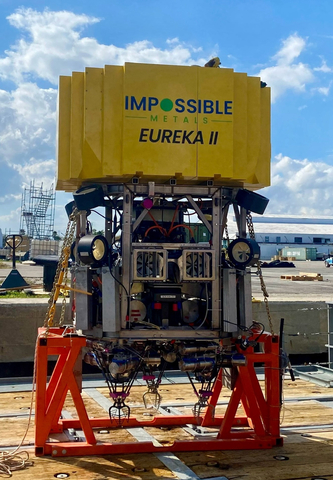
When asked about the unknown unknowns question they respond:
What scope is there for potential unexpected consequences of seabed mining?
I would say that there is not going to be a yes or no answer to that, in the same way that there will never be a yes or no answer to that with any human impact on any project. That makes it a complicated or not-straightforward question.
The work that we will be doing will have an impact. Even with our minimally invasive approach, there is an impact – and it’s critical as a society for us to understand and study those impacts and then collect these metals in a way that has a net benefit for the planet but also has minimum negative impacts.
I think this is reasonable. I err on the side of caution to protect the delicate balance of nature, and they err on the side of taking risks for the sake economic pragmatism.
If Burgum does get his way, we should at least be enforcing use of the minimally invasive technologies, like Impossible Metals.
From the article on “dark oxygen” I linked:
According to Boston University microbiologist Jeffrey Marlow, the idea that some of Earth’s oxygen gas may come not from photosynthesizing organisms but from inanimate minerals in total darkness “really strongly goes against what we traditionally think of as where oxygen is made and how it’s made.” Marlow is a co-author of the new study, which was published in Nature Geoscience.
The mechanism appears to be these polymetallic nodules acting as natural underwater batteries that can exhibit up to a volt of charge!
“Amazingly, there was almost a volt [of electric charge] on the surface of these nodules,” Sweetman says; for comparison, an AA battery carries about 1.5 volts. The nodules may become charged as they grow, as different metals are deposited irregularly over the course of millions of years and a gradient of charge develops between each layer.
Since the nodules are charged, oxygen is produced through what is called “seawater electrolysis”.