“What would be more absurd than to ask that you give yourself to me, you who are all in all? And how will you give yourself to me if you do not at the same time give me heaven and earth and all that are in them? And, even more, how will you give me yourself if you do not also give me myself? And when I thus rest in the silence of contemplation, you, Lord, answer me within my heart, saying: “Be yours and I too will be yours!” - Nicholas of Cusa
Surely the angels work through Disney movies. They’re getting more and more spiritual. I’m happy for the kids growing up on Soul, Inside Out, and Coco.
I recently watched Moana for the first time. There’s one three minute scene that is so dense with deep messages I wanted to unpack it fully.
The scene is of Maui hitting rock bottom. The valley of his hero’s journey. Here’s the clip on Youtube.
Moana and Maui are on a boat, on their mission. Maui doesn’t want to go on. He’s lost his divinely blessed, ultra powerful, fish hook weapon, and he feels helpless.
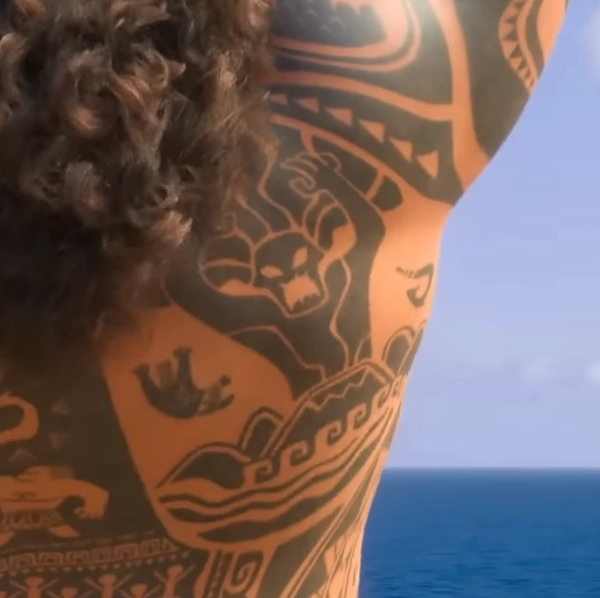
Moana thinks to ask Maui about his tattoos. Maui says each tattoo, a permanent mark on his body, shows up “when he earns them”.
(Lesson 1: The body keeps the score.)
Moana asks Maui about a specific tattoo of his parents throwing him into the sea. Maui doesn’t want to talk about it. Moana says if he doesn’t open up now, she’ll just keep asking.
(Lesson 2: Life will keep poking at us (Moana literally pokes him with an oar) until we open up and confront what is inside us).
Moana says she needs to fulfill her quest and save the island. And it’s just her and Maui on that boat. And she wants to help Maui, but can’t if he doesn’t let her.
(Lesson 3: It’s Moana’s drive to fulfill her own purpose that is the natural cause of her shining a light on Maui’s wounds, and ultimately helping him heal. In being herself, she naturally attracts the people she must help.)
(Lesson 4: Life cannot force you to open up. It can ring and bang and scream, but ultimately you must be the one to open the door. Speaking it is the first step. Acknowledgement brings light to darkness.)
Maui explains that his parents threw him into the ocean as a baby. They didn’t want him. They abandoned him.
But the God’s saved him from the ocean.
(Lesson 5: We are always under the graceful eyes of God. And God is our refuge in our abandonment).
And the God’s turned him into a demi-God, and gave him a powerful weapon and immense knowledge of divine secrets.
(Lesson 6: By God’s grace, great suffering is transmuted into great wisdom.)
But still, he carried his abandonment wound, and it drove him to seek love and acceptance from humans. He gave them fire, coconuts, and the heart of creative power— but it was never enough.
Moana says, “You did everything for them. So they’d love you.” She emphasizes “them”. Maui strove to please humans, rather than the God’s that saved him.
(Lesson 7: Trying to earn love from humans will often end in pain. So what are we called to do instead?)
Then Moana speaks these words to him, “Maybe the God's found you for a reason. Maybe the Ocean brought you to them, because it saw someone who is worthy of being saved. But the God's aren't the ones who make you Maui. You are."
(Lesson 8: “The God’s found you for a reason”— a Calvinist might hear this and think Maui was elected. Maui was one of those lucky beings chosen by God to be saved. But I doubt the Disney writers are Calvinists. The message is probably: we are all worthy in God’s eyes.)
And, the biggest lesson, lesson 9:
“The God's aren't the ones who make you Maui. You are.”
Now, I don’t know what reality is. I don’t know if there’s a Maui or a Karthik. A separate self or non-separate self. Free-will or no free will. Or if such a question is even answerable or unanswerable.1
But I do know that the words: “You make yourself” give power. And the words “God makes you” drains power.
I think this is the mysterious power behind the Nicholas of Cusa quote: “Be yours, and I will be yours.”
“Be yours, and I will be yours.” It reconciles our experience of free will, of individuality, and of “making ourselves” with the knowledge that there is an immense, omnipotent, higher power that can “make us” in an instant— yet chooses not to, because, maybe, it just wants us to be human.
Cusa seems to ponder this to, when he says “how will you give me yourself if you do not also give me myself”