my friend neall once got into wine tasting and said that learning the names of the different flavor notes increased the clarity, richness, and sensitivity of his sense of taste.
in other words, learning abstract words and concepts changed his perception of reality.
this is basically the sapir-whorf hypothesis.
somehow, abstract thought vibrations in our head (aka words) change how we perceive the world.
this is amazing news for wordcels everywhere.
i’m currently learning the names of obscure colors to see if it changes my visual perception of the world.
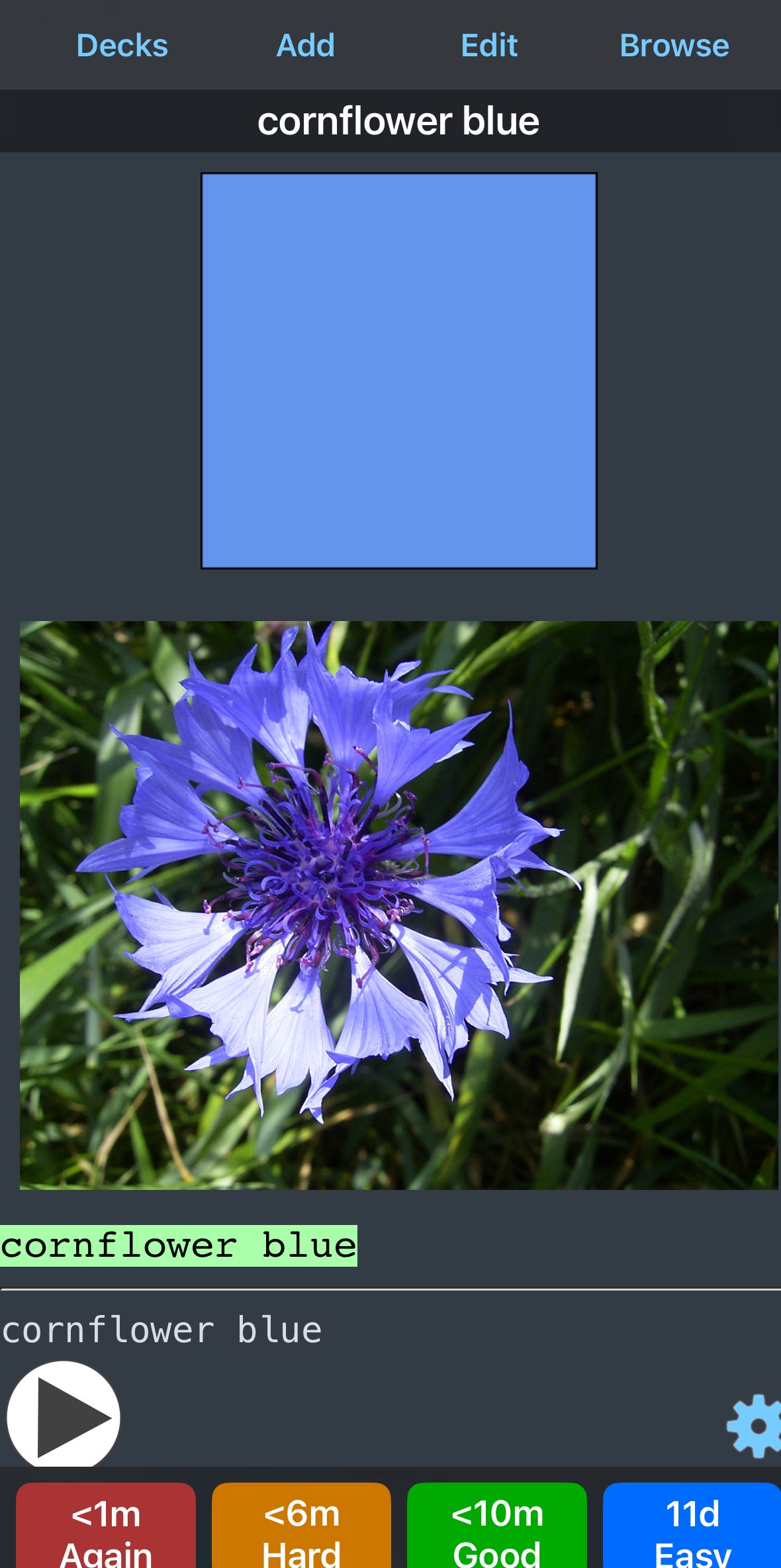
i downloaded this goofy anki deck:
and copped Werner’s nomenclature of colors, which Charles Darwin used to describe critters in more exact language.
a beautiful thing about this book is it includes the natural source of each color. if you want the most beautiful example of this ever, ask a friendly LLM about the relationship between Isaiah 1:18, the color crimson, and the tola’ath worm.
apparently Russian speakers distinguish shades of blue 10% faster than English speakers because they have colloquial words for light and dark blue.
that’s cool. but two different blues is child’s play. i’m learning fifty categories of blue. i’m using cornflower, ultramarine, and periwinkle in day to day speech and thought. no, i will go beyond. i will learn perfect pitch, but for colors. i will perceive the exact nanometer wavelength of every color on the visible and invisible spectrum. i will become a human spectrometer.
anyway, what does all this have to do with grammar?
grammar is one of the three liberal arts of the trivium. classical education theorists claim it is extremely important. but most of us moderns find it extremely lame.
but it is not lame. grammar is glorious. it’s just that our terrible schools did not present it in its full glory.
grammar is the art of noticing distinctions and similarities between things. it is also the art of categorizing.
in the grammar of language, we group words by verb and noun classes. we divide sentences by parts of speech.
but in the classical sense, any kind of taxonomizing, categorization, observation of similarities and differences can be considered grammar. to learn to identify plants, for example, is to learn the grammar of plants. to learn to name emotions is to learn the grammar of emotions (e.g. an emotion wheel).
organizing is a fundamental pleasure of the human being. people love putting trays of different sizes in their drawers and placing objects of similar categories into these trays. people love bento boxes that separate the categories of their meal into neat compartments.

why? reality is grammatical. the human being wants to do grammar. this is what the philosophers have discovered. by noticing similarities and distinctions and types, we approach a deeper and more subtle understanding of reality.