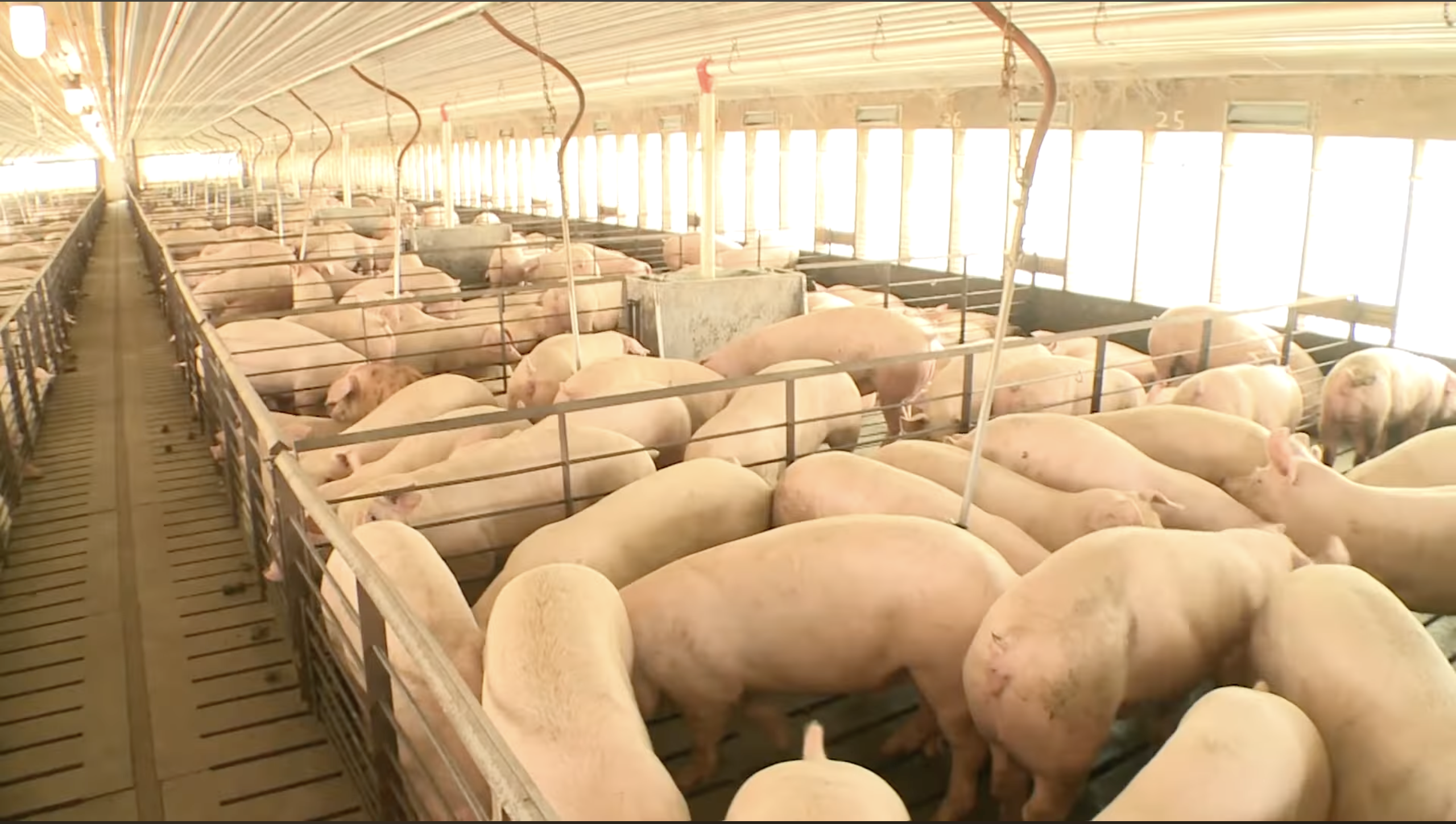
An unloaded semi truck weighs 35,000 pounds. A Boeing 737 weighs 90,000 pounds.
Put both together, and you’re in the ballpark of the daily hog sewage produced by a Smithfield hog farm in North Carolina, weighing in at around 153,000 pounds. Per DAY!1
That Smithfield location cages almost 15,000 hogs, each producing around ten pounds of waste per day.
How do factory farms handle all that waste?
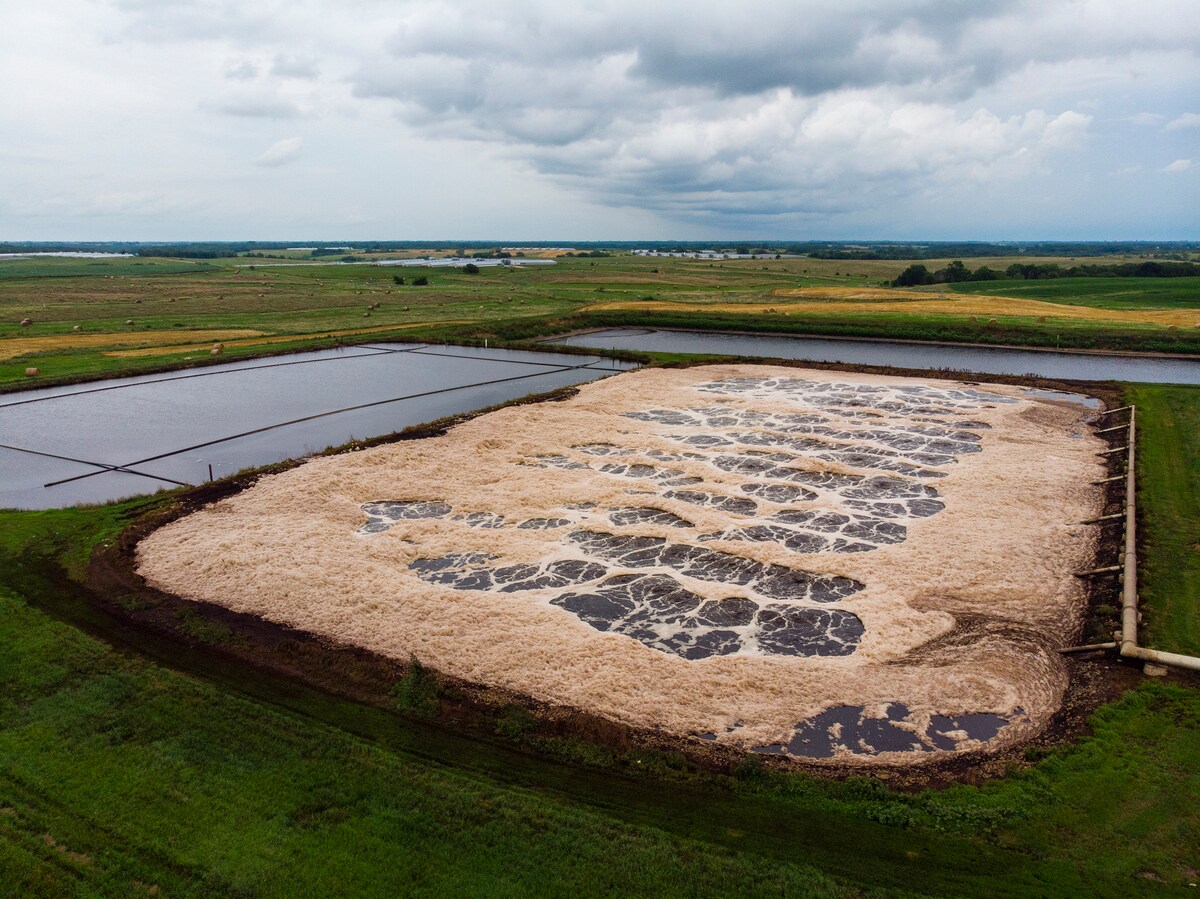
That’s how. Gigantic fecal lagoons. Millions and millions of gallons.
Try and imagine it. The nauseating smell. The eye-burning stench. The steaming, hot, noxious gasses that get stuck in your throat.
The smell destroys whole counties. Neighbors can’t open their windows or step outside. It’s not just the smell, but also because those noxious vapors carry all kinds of pathogenic bacteria that can cause upper respiratory issues.2
Just imagine: you move your family to a new homestead in Iowa. You dream of a peaceful new life in the majestic serenity of the rolling hills. You take out a mortgage, set down your bags, and think to yourself, finally, this is it.
Then, three months later, Porkmasters Incorporated shows up with 3,000 hogs in tow and digs a fifty-million-gallon shit lagoon down the road from you. And now you’ll never enjoy your backyard ever again.
I’m not making this up. This actually happens. It’s tragic and deeply unfair. A chosen few might win a small nuisance suit. But in the majority of cases, courts rule in favor of big ag.
At some point in the year, farmworkers must face this monstrosity.
They must drain the fecal lagoon.
First, they stir the waste slurry, then they pump it into tankers to be spread out on the farm as “fertilizer”.
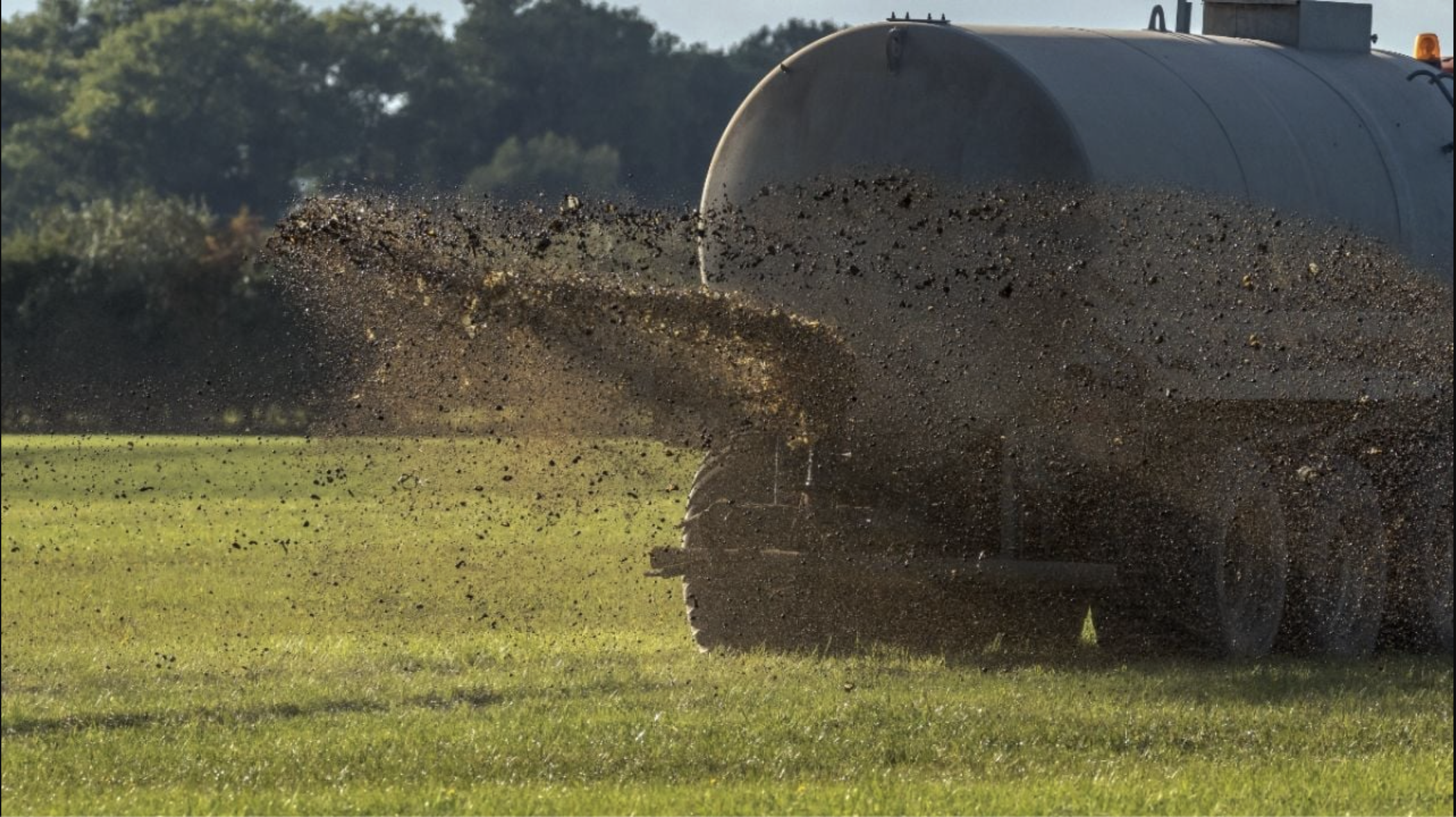
In normal conditions, manure makes a wonderful fertilizer.
But one must ask: does this gargantuan, noxious, fecal goon that’s been brewing pathogenic bacteria in stagnant water for six months have the same properties as well-composted manure? I’d like to see some clear research on this.
Whether or not rotting poop-slurry is good for the land is one issue. The other issue is: can 300 acres of land even take FIFTY-FIVE MILLION pounds of waste per year? Now there is clear research on this. And the answer is no. The waste sits on the land until it rains or storms, and all that unabsorbed, rotting, pathogen-incubating fecal matter is then washed into streams, ponds, lakes, and rivers.
And to make matters worse, many of these lagoons are unlined pits, meaning the fecal lagoon water is also leaching into the soil, slowly making its way into the groundwater.
I for one do not believe nature is designed to handle waste at these concentrations.
The pollution from dumping, while bad, is not the worst way farmers get rid of animal waste.
There’s also the spray-and-pray method, formally referred to as the lagoon-and-sprayfield method.
Farms like Kinlaw in North Carolina spray millions of gallons of feces water into the air. Around eight million gallons per year.
The neighbors, as you can imagine, are not happy about this.
Suffering from severe health and quality-of-life issues, ranging from chronic respiratory illnesses to birth defects, they requested Kinlaw to at least not spray feces at them during their weddings and cookouts.
Kinlaw Farms ignored the request and continued to “spray hog waste in summer months three to five days a week for an average of six hours per day.”3
The world of fecal lagoon management policy is quite intricate and nuanced. But the core idea is this: it is technically illegal to dump your manure directly into a water body. And it is technically illegal to overload your field with manure. Overloading the field is bad for many reasons, but the biggest problem is that it will run off the fields and contaminate shared waterways.
We know it’s an issue. And there’s some legislation against it. But enforcement is a major bottleneck.
In most states, farmers are not required to get federal waste discharge permits (NPDES), so it’s up to the states to enforce controls.
And if you’re in a big-ag-friendly state like Iowa, well, you can get away with a lot. And even if the state wanted to enforce, most of these agencies are too under-resourced to really crack down on factory farm pollution.
Since most state agencies can’t or won’t enforce the limits, farmers are free to heap tons of frothing fecal water onto their land, then just shrug their shoulders as the rain washes millions of gallons of it into our shared waterways. Some farms even dump in the winter, when the land is frozen over and covered with snow and can’t absorb any of the “fertilizer”.
On the bright side, literally spraying feces at people is slowly being banned. New sprayfields are illegal in all states.
But some existing sprayfields are exempt! In North Carolina, for example, the law says that if you were spraying hog feces at people before 1997, when the sprayfield ban was first passed, you’re exempt from the ban! You’re “grandfathered in”, meaning you can spray hog feces at whoever you’d like, and can continue to do so for the rest of eternity.
The fecal lagoon problem is one of those absurd problems that come with industrial society, and moving from family farms to factory farms, a.k.a “Concentrated Animal Feeding Operations”.
A porta potty holds around fifty gallons of waste. But even at 20-30% capacity, they’re a clear offense to God.
These fecal lagoons hold millions—MILLIONS! — of gallons of waste.
Yes, it’s true that humans also generate millions of gallons of waste (still less per capita than hogs!)4. But humans have highly developed waste management systems. Imagine if your city’s waste management system was just one big open porta potty, cleaned once or twice a year.
Our handling of animal waste is way too primitive considering the scale of farming operations.
Thankfully, there are some easy improvements we can make to the fecal lagoon situation. We just need a bit of political will.
Here’s a dead simple improvement: mandate liners for fecal lagoons so that the slurry stops leaching into the soil. Some states have already passed such laws. Other states are still too lax. Hawaii, for example, only requires a liner if the lagoon is near a drinking water source. But if your fecal lagoon is next to a forest preserve, no liner needed.
Here’s another easy improvement: mandate covering every lagoon with tarp so the smell stops escaping. One reason farms don’t do this already is because there’s so much methane produced by the lagoons that it’s actually dangerous to just throw a tarp over it. But there’s a solution: siphon out the methane in tubes and turn it into biogas. Some farms already do this. California even has a subsidy program for it (which is unfortunately also flawed and a whole other controversy.)
Another needed mandate: everyone must stop spraying feces at people. North Carolina tried to pass a bill to get feces sprayers to stop by 2027. But the bill has been stalled.
And another: force factory farms to properly steward nearby water bodies. Fine them if their poop slurry washes into a lake. Wisconsin recently made baby step towards this by making it legal for these types of requirements to be included in factory farm permits. Now they just need to include the requirements. All states should follow suit.
Enforcement is of course a challenge. Like I said, agencies are underfunded. They might send a guy out to the farm once every year or five to manually check up on things.5 Most enforcement is done through lawyers and researchers at public interest NGOs. But these NGOs are also struggling to keep up with the work demanded by surveillance and enforcement. The Environmental Working Group, for example, manually sifts through thousands of blurry satellite images to build their cases against factory farms.6
But there are solutions for this too! Technology can actually help. This wonderful paper out of Stanford’s Regulatory Lab shows how satellite imagery + AI can accurately report the amount of waste factory farms are applying, so regulators and watchdogs don’t need to stake out the fecal lagoons themselves.
The researchers focused on winter applications in Wisconsin, which are only allowed in special “emergency circumstances”. They found that most farms are either significantly under-reporting their manure applications, or being granted undisclosed emergency exemptions by the state at a high rate.
I’m sure people smarter than me can get even more creative. Maybe there are low-cost treatments to manage the fecal lagoon toxicity? Maybe using special enzymes or helpful bacteria?
And, more ambitiously, can we make biogas more useful so that it’s more profitable to produce? And then can we force factory farms to spend some of those profits on healthier waste management systems?
Or, most ambitiously of all, can we just ban Concentrated Animal Feeding Operations altogether and return to family farms?7
SRAP (the Socially Responsible Agriculture Project) has a great guide to protecting water quality from factory farm pollution in California. There are pointers on how to get involved with your regional water board, which has the most jurisdiction in this area (see p. 6-7 in the guide for links and information on regional water boards). Waste lagoon pit liners, for example, are enforced at a regional level (see page two for an example). There are also opportunities for public comment at the state level. I will try and track and flag the ones that seem most relevant as they come up.
SRAP also runs a grassroots Water Rangers program in certain states. The program trains citizens to test local water bodies to help flag pollution and waste discharge violations.
Lee Zeldin, Trump’s EPA pick, is especially lax on cracking down on farms violating their waste discharge permits. Food and Water Watch is a wonderful group that litigates against federal agencies (one of the great vectors of change in our system of government!) so our courts can force them to act. You can give to them here. The Waterkeeper Alliance is doing similar work.
Oregon (SB 80), Iowa (SF 183), and other states are trying to pass statewide legislation against factory farming pollution. Raise your voice in favor! Emailing representatives and tweeting about stuff are low-effort actions that can actually make a difference. You might not get a real reply, but staffers use inbound emails to gauge what issues voters actually care about, so it’s important!
It can be overwhelming to navigate all this, but I hope to track and flag strategic opportunities in California (my home), and at the federal level as they come up.
Thank you for reading and I wish you all the best.
I spent hours quadruple-checking this statistic because it was so unbelievable to me at first. You can read my hog waste research notes here.
Health effects of airborne exposures from concentrated animal feeding operations. Environmental Health Perspectives. 2007.
Bill Shultz, Who Will Keep the Poop Out of the Water?: The Latest in the Saga of CAFO Regulation Under the Clean Water Act, Georgetown Envtl. L. Rev. (blog), Dec. 4, 2023.
A 2010 report partially funded and supported by the CDC estimated that annual manure production from CAFOs of all types was between three and twenty times that produced by humans – a total of between 1.2 and 1.37 billion tons of waste per year.
Currently, the volume of inspections is extremely low: major facilities permitted under the Clean Water Act are required to be visited once every two years; minor facilities are required to be visited once every five years; and in fact, many facilities are never visited at all [14, 46].
Ibid.
First, we obtained the location of 330 CAFOs in Wisconsin from the Environmental Working Group (EWG), which spent many months manually scanning satellite imagery to identify CAFO locations.
Larger NGOs are already working on broader farm system reform. The Farm System Reform Act of 2023, introduced by Senator Cory Booker, ambitiously called for a moratorium on all factory farms by 2041, along with debt forgiveness and transitional aid to factory farmers! Unfortunately, we’ll need to wait for more eco-friendly congressional agriculture committees before it can move forward.